WRMP
Sign up for updates!
Public Data Access Coming Soon – Click here to be notified by the San Francisco Estuary Wetlands Regional Monitoring Program when data is released. Register for the lidar data release webinar (August 5, 12-1:30 pm).
The challenge
Elevation data across the Bay-Delta has historically been collected through separate, project-by-project acquisitions, resulting in uneven specifications, timing, and processing approaches. Without shared planning or pooled resources, coverage is fragmented, costs are higher for individual programs, and datasets are less consistent and less useful across jurisdictions. That fragmentation has real consequences. Without accurate elevation data, communities across the Estuary are making consequential decisions, where to live, whether to evacuate, and how to plan for the future, based on a picture of the landscape that no longer exists.
The solution
To address this, the San Francisco Estuary Wetlands Regional Monitoring Program (WRMP), the California Department of Water Resources, and the Delta Stewardship Council collaborated to collect lidar data across the entire San Francisco Bay-Delta Estuary at sub-ten-centimeter vertical accuracy.
This lidar project provides high-resolution, region-wide elevation data offering an unprecedented view of the landscape, landforms, and habitat conditions. Fine-scale features captured across the estuary make this a shared foundation for researchers, engineers, and land managers working to mitigate flood risk, improve habitat restoration, monitor subsidence, and more.
Once available, links to the data and information about a forthcoming webinar will be posted on this web page. In the meantime, sign up to be notified when the data is made available by the WRMP.
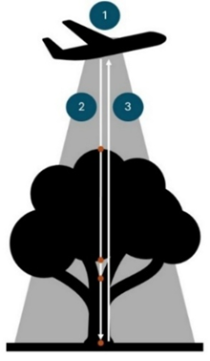
The light detection and ranging (lidar) approach
Lidar is a remote sensing technology that uses laser pulses to measure the shape of the land and objects on it.
- Airplane flies back and forth over the survey area
- Laser pulses sent down to bounce off Earth’s surfaces
- Laser signals (pulses) return to the plane
By measuring how long each laser pulse takes to return, lidar systems calculate precise distances and create a highly detailed, three-dimensional model of the landscape. The raw laser “returns” are processed and cleaned using a combination of automated methods, including artificial intelligence (AI), and manual review to ensure accuracy. Because some laser pulses can pass through gaps in vegetation, lidar can often “see” the ground beneath tree canopies, providing a clear view of underlying surfaces.
Presentation on the newly collected lidar to the Delta Stewardship Council Meeting (Lidar topic 35:31-55:00)
Frequently Asked Questions
What is lidar used for?
This data enables researchers, agencies, and communities to better visualize changes in topography, habitat distribution, and flood risk. By providing consistent, accurate, and comprehensive coverage, the lidar data supports a wide range of applications, including wetland and habitat mapping, hydrodynamic and sea-level rise modeling, and tracking landscape change such as land subsidence or geomorphic shifts over time.
- Researchers can use the data to study habitat dynamics, model ecological processes, and evaluate restoration outcomes.
- Agencies and planners can integrate the information into flood risk management, levee and infrastructure planning, and climate adaptation strategies.
Community organizations and other local interested parties can also use the data to understand environmental conditions in their neighborhoods and inform local projects.
How can I access the data?
The lidar data from this collaborative collection will be publicly available through multiple platforms.
All lidar data, including raw point cloud files and derived elevation products, will be accessible through NOAA’s Digital Coast Data Access Viewer. The Viewer allows users to download complete datasets and generate customized data products based on their area and parameters of interest, making the data usable for both technical and non-technical users.
The California Natural Resources Agency (CNRA) Open Data Portal will also host the entirety of raw point cloud files and derived data products, providing a centralized access point for downloading and reusing the data.
The San Francisco Estuary Institute Data Center will host regionally mosaicked elevation products, such as digital elevation models (DEMs) and normalized digital surface models (nDSMs), designed to support consistent analysis across the Bay and Delta.
The data is also expected to be integrated into the United States Geological Survey (USGS National Map) through the 3D Elevation Program (3DEP), supporting national-scale access and long-term preservation. Integration timelines for 3DEP vary and will occur at a later date.
Once available, links to the data and information about a forthcoming webinar will be posted on this web page. In the meantime, sign up to be notified when the data is made available by the WRMP.
What area does the data cover?
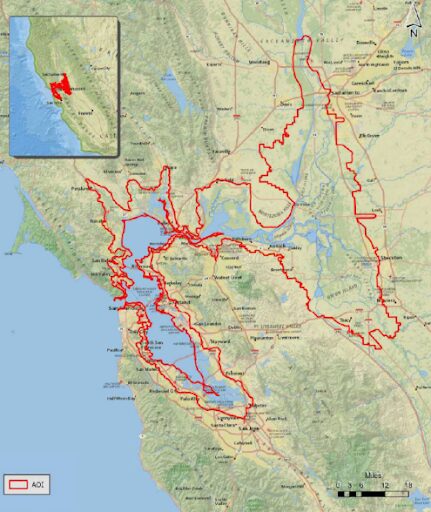
This lidar collection covers the entirety of the San Francisco Bay-Delta Estuary, spanning approximately 1.25 million acres, an area roughly the size of the state of Delaware! This provides consistent elevation coverage across shoreline, wetland, upland, and developed areas throughout the estuary.
Data was collected using multiple flight swaths, with acquisition timed to account for varying water levels across the Bay-Delta. Because water levels influence how much of the ground surface is exposed at the time of collection, information on estimated tide levels helps users interpret elevation data in tidally influenced areas. Lidar does not penetrate water well, so areas covered by open water at the time of collection may not have true ground elevations.
An interactive web map is available, allowing users to explore the project extent, examine individual flight swaths, and view hydro-flattened areas. The hydro-flattened layer displays the location where water surfaces were artificially flattened during processing to create hydrologically consistent elevation models. Map pop-ups display details such as collection date, time, and estimated tide level, helping users better understand local acquisition conditions and data characteristics.
What data products will be available?
A suite of raw and processed lidar-derived data products will be available in standard GIS-ready formats (e.g., GeoTIFFs and LAZ point clouds), supporting a wide range of analysis and visualization needs.
- 1-foot Hydro-flattened Digital Elevation Model (DEM)
- Represents the bare-earth ground surface at 1-foot resolution. Areas covered by open water at the time of collection are artificially flattened to a minimum elevation value to produce a hydrologically consistent surface suitable for modeling and mapping.
- 1-foot Digital Surface Model (DSM) and normalized Digital Surface Model (nDSM)
- The DSM represents the highest laser return at each location, capturing vegetation, buildings, and other structures. The nDSM represents the height of those features relative to the ground surface by subtracting the DEM, allowing users to estimate vegetation or structure height.
- 1-foot Normalized Intensity Image
- Represents the strength of the first laser return. Higher values typically correspond to solid, reflective surfaces, while lower values are associated with vegetation, water, or less reflective materials.
- 2-foot Terrain Derivatives
- Slope describes surface steepness or gradient. Includes slope of DEM and nDSM
- Aspect indicates the compass direction a surface faces (0 – 360 degrees).
- Hillshade provides a shaded relief visualization that enhances terrain and surface features. Includes hillshade of DEM and DSM
- 2 ft Topographic Indices
- Topographic Position Index (TPI) compares the elevation of a location to its surrounding neighborhood, helping identify features such as ridges, flats, and depressions.
- Topographic Openness Index (TOI) quantifies how enclosed or open a location is relative to surrounding terrain by evaluating lines of sight.
- Classified Point Cloud
- Includes standard classification categories such as ground, low, medium, and high vegetation, buildings, vehicles, fences, water, bridge decks, wires and transmission towers, and noise classes, enabling custom product generation and advanced analyses.
What’s the quality of the data?
This lidar collection meets Quality Level 1 (QL1) standards as defined by the USGS. USGS quality levels provide a consistent way to compare lidar datasets based on point density and elevation accuracy, with a particular focus on the reliability of derived digital elevation models (DEMs). QL 1 represents one of the highest commonly used standards for regional lidar mapping, with only QL 0 exceeding it.
The dataset has an average point density of approximately 12 laser pulses per square meter, supporting a detailed representation of terrain and surface features. Independent accuracy assessments indicate a horizontal accuracy of approximately 13 centimeters, a Non-Vegetated Vertical Accuracy (NVA) of 6.7 centimeters, and a Vegetated Vertical Accuracy (VVA) of 27.6 centimeters, reflective of expected differences in performance between open ground and vegetated areas.
To evaluate accuracy, survey control was collected across the region using high-precision RTK GPS methods. A total of 166 ground survey points were collected, with 84 used to assess non-vegetated vertical accuracy, 31 to assess vegetated vertical accuracy, and 51 used for calibration.
Together, these characteristics make the dataset well-suited for applications that require reliable, high-resolution elevation information, including coastal and floodplain analysis, habitat mapping, infrastructure planning, and long-term change detection.
Why was it important for this work to be conducted collaboratively?
By collecting lidar data collaboratively across the San Francisco Bay-Delta Estuary, this effort produces a more complete and reliable dataset than would be possible through individual, project-by-project acquisitions. Coordinating data collection across the entire estuary allows for consistent specifications, timing, and processing methods, resulting in seamless elevation coverage spanning multiple jurisdictions and management boundaries.
This region-wide approach is particularly important in a complex, tidally influenced system like the Bay-Delta, where elevation, hydrology, and habitat processes do not align with political boundaries. Shared planning around flight conditions, survey control, and quality assurance helps ensure the data meet the needs of multiple programs and decision-makers, from regional monitoring and modeling efforts to local planning and restoration projects.
Collaboration also results in significant cost savings for participating organizations. By pooling resources, agencies and partners avoid duplicative lidar collections and gain access to high-quality, region-wide elevation data that would be prohibitively expensive to obtain individually.
Who contributed funding to this effort?
This lidar collection collaboration would not be possible without funding support from the Wetlands Regional Monitoring Program (awarded by the San Francisco Bay Restoration Authority), the Delta Stewardship Council, the California Department of Water Resources, the South Bay Salt Pond Restoration Project, and Valley Water (Santa Clara County). The project was jointly managed by the San Francisco Estuary Institute, California Department of Water Resources, and Delta Stewardship Council, with NV5 serving as the lidar acquisition and processing contractor.
What’s next?
This collaborative effort sets the stage for future, region-wide lidar collections that support long-term monitoring and planning across the Bay-Delta. Continued coordination and shared funding can help ensure that elevation data are updated regularly, enabling direct measurement of elevation change over time across both the ground surface and aboveground features. This includes tracking patterns of accretion, erosion, subsidence, and geomorphic change, as well as changes in vegetation structure and built features. If your organization is interested in participating in or helping shape a future regional collection, including a potential update around 2030, we encourage you to reach out to learn more or get involved. Email our team at [email protected] today!
Timeline and Next Steps:
- Data acquisition occurred between August and October 2025 by contractor
- Contractor completed an initial quality assurance and quality control process.
- Data was delivered to project partners in February 2026.
- All data products are currently being reviewed for quality assurance and quality control by the project partners to ensure all aspects of the data delivery meet the needs of the respective agencies.
- Project partners QAQC process from February to end of May. Coordinated feedback will be supplied to the lidar contractor.
- The lidar contractor will then implement changes and finalize the data.
- The final products are expected to be publicly available online and for download in July 2026.
- A free webinar will be held around this time to provide further information and include hands-on examples and demonstrations for access and use of the data. Please sign up here to be notified when the date is chosen and to receive instructions on how to register.
- Building on this lidar collection, San Francisco Estuary Institute will apply vegetation-correction methods to estimate true ground elevation beneath dense vegetation better. This work is currently funded for San Francisco Bay marshes, with parallel efforts being explored for the Delta.